Our proposal
A temporary, international pause on training the most powerful general AI systems, until we know how to build them safely and keep them under democratic control.
No country or company will stop on its own while others keep racing. That is why the pause has to be international, agreed in a treaty and enforced together.
What the treaty should contain
An international AI Safety Agency, modelled on the International Atomic Energy Agency. It would:
- approve large training runs and deployments only when they are judged not to threaten humanity, after red-teaming and evaluations;
- allow more powerful AI only once the technical problems of safety and control are actually solved;
- set the rules for overseeing training runs;
- verify that the rules are followed: tracking AI chips, inspecting data centres and chip factories, monitoring energy use, and protecting whistleblowers.
A veto for the world. A large enough coalition of countries can block the deployment of a superhuman AI system, and no single company or country may capture all the wealth it creates.
What it would not affect
The pause targets the largest general AI models, the ones that can understand language and act across many domains. Narrow tools, such as image recognition that helps diagnose cancer, would carry on as before.
Why Belgium has a role
Brussels is where the EU writes its AI rules. The EU AI Act already treats the most capable models as a source of systemic risk, and its Code of Practice asks their makers to assess and reduce those risks. Belgium can push the EU to go further: to put an international pause on the table at the next AI summit, and to back the verification tools that would make it enforceable.
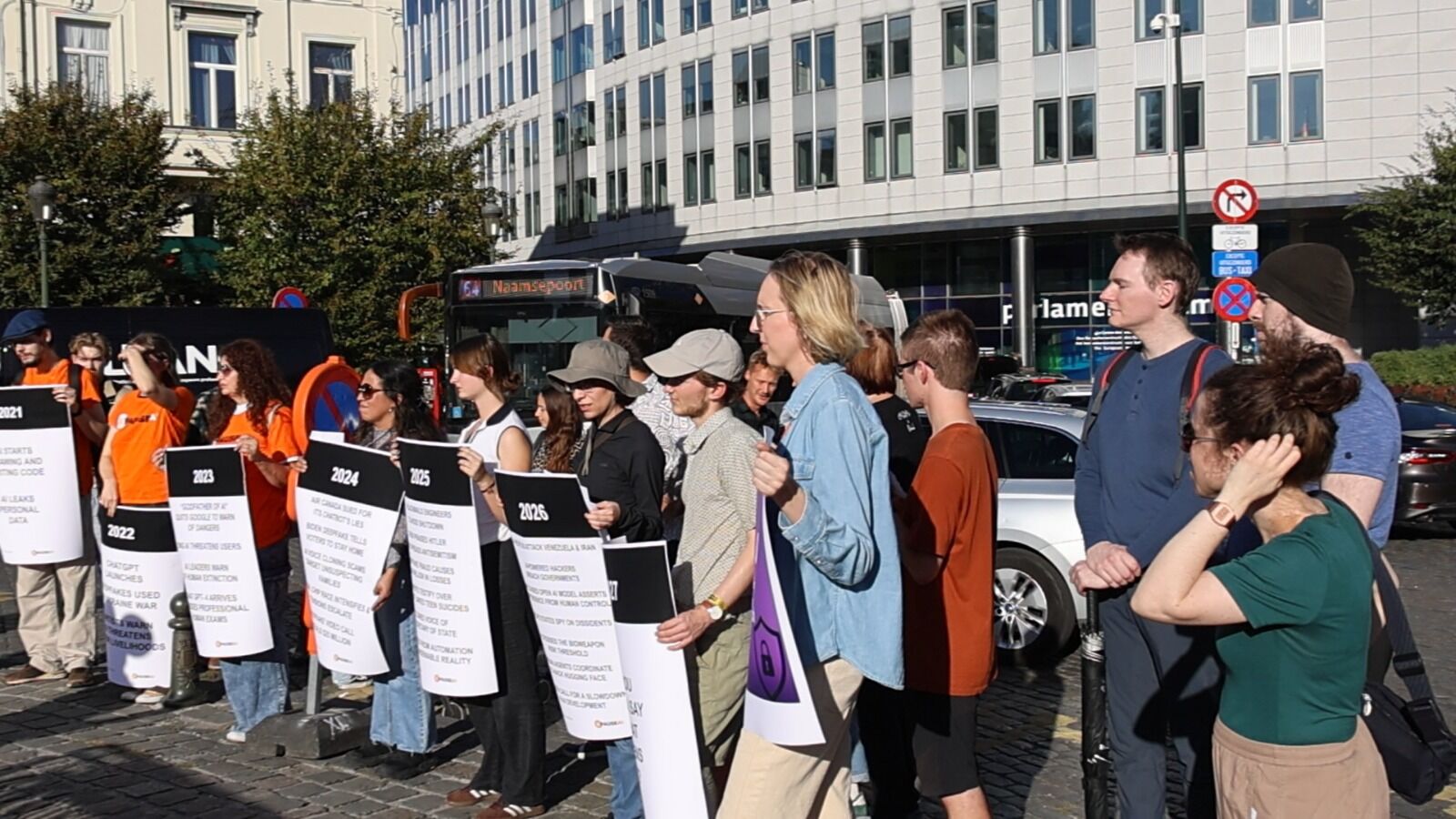 Volunteers and supporters in front of the European Parliament.
What if it went well?
A good future, concretely: what it would look like, and how we get there.
- We stop gambling. After more and more serious incidents, and under pressure from citizens, governments admit that nobody controls the most advanced AI, and agree to talk.
- A verifiable treaty. The United States, China and Europe sign a temporary pause on training the most powerful AI. It can be verified like nuclear arms: cutting-edge chips come out of a handful of factories, and giant data centres cannot hide.
- No single master. Frontier research becomes public and computing power is tracked. Dozens of companies in several countries reach the same level and move forward together, with no decisive lead for anyone. Cheaters are spotted, and the others can stop them.
- Nobody keeps AI for themselves. What labs do internally is declared and audited by independent inspectors; the most sensitive uses need the agreement of several institutions, never just one. No company or government can use AI to seize power.
- Research changes target. During the pause, the best minds work on understanding and controlling AI, not on making it more powerful. Today’s AI, already very useful, serves medicine, science and decarbonisation.
- Step by step. Each more powerful generation is allowed only once we know how to make it safe, and when democratic institutions, not just a few companies, decide.
- The benefits without the gamble. Better health, more science, less CO₂, and a humanity that stays in charge. This is not science fiction: it is what we did for CFCs and human cloning.
For a detailed version of this path, read Plan A by the team behind AI 2027.
Read the full proposal
This page summarises the PauseAI proposal (version of 5 April 2026), which covers getting to a treaty, enforcement, and long-term safeguards in more detail.